Skip to content
911.SHOWCASE
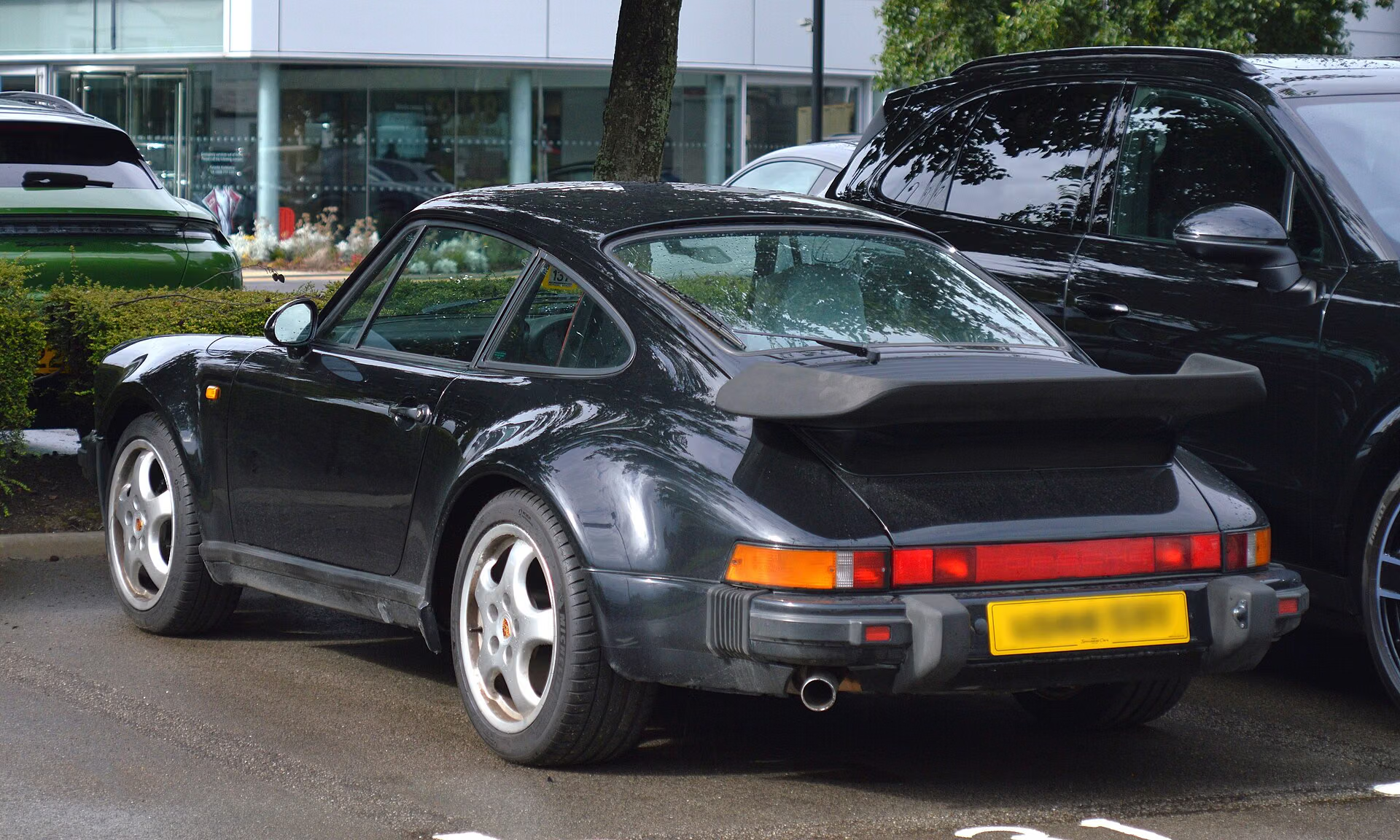
911 Turbo S LM-GT — stand-in photo (same 964 family, sibling trim)

911 Turbo S LM-GT

1993–1994Coupé

The Turbo S LM-GT was Porsche's 1993 assault on GT racing, started from a road-legal 964 Turbo S and stripped for the circuit: a deep chin spoiler, two air inlets above the rear arches, an adjustable racing wing on top of the standard wing, and widened arches for 12-inch slicks. Inside were a roll cage, plastic windows and no trim. Crucially the engine was not the road unit but a 3.2-litre twin-turbo making 475 hp. The Brumos entry of Röhrl, Stuck and Haywood finished seventh overall and first in class at the 1993 12 Hours of Sebring, then ran as a works car at Le Mans before failing. For 1994 it went to Larbre Compétition with a 993-based 3.6 twin-turbo, winning the 24 Hours of Daytona and four BPR Global GT races. The programme fed directly into the 993 GT2.

SpecificationsSound: Porsche 911 R (1967)Edvvc · CC BY-SA 3.0 · Commons (opens in a new tab)

Unofficial fan showcase · media licensed per asset

Specification plate

Numbers as published

Every figure below is quoted from the sources listed at the foot of the page. A dash means the number was never published — it is never estimated.

Engine

3.2 L

twin-turbocharged flat-six, 475 hp (1993 works car); 3.6 L twin-turbocharged flat-six derived from the 993 unit (1994, Larbre Compétition)

Power

475 hp

1993, per Wikipedia/Porsche Motorsport history)

0–100 km/h

—

Not published: No verified torque, gearbox, acceleration, top speed or dry weight; all left null.

Top speed

—

Not published: This variant id is an APPEND (not in data/roster.json). The LM-GT is a race car rather than a road model, but it is the 964 generation's most consequential motorsport achievement and is documented on Porsche's own motorsport site.

Weight

—

Not published: The 475 hp figure is given by Wikipedia for the 3.2 twin-turbo and is not expressed in PS/kW; powerPs and powerKw are left null.

Drivetrain

Rear-wheel drive

Transmission

—

Not published: Wikipedia's Wikipedia-derived 475 hp is a bare figure with no rpm reference; it is reproduced as published.

Production

Two cars — the 1993 Brumos/Porsche works entry and the 1994 Larbre Compétition car, which was sold at the end of the year

Body styles

Coupé

3D viewer

Look closer

No model on file yet

No free-licensed 3D of this car yet

911 Turbo S LM-GT

Every model on this site is licence-checked by hand before it can ship, and no capture of this car clears that bar yet. The archive photograph is what we can show honestly today.

Pipeline: licensed local model → Sketchfab embed → turntable · sources on the credits page

Paint

No 3D model on file for this variant yet.

Wheels
StockSportTurbo

No 3D model on file for this variant yet.

Gallery

Click a frame · Esc closes · ←/→ move

Watch

4 films on the Turbo S LM-GT

Variant-specific films first, then the curated set for the generation. Every player is an embed that loads on click.

  • Generation · MotorWeek

    1989 Porsche 911 Carrera 4 | Retro Review

    Jay Leno-era retrospective drive of the first AWD 911

  • Generation · Number 27

    From Most Hated to Most Loved, Is Porsche's 964 Now Overhyped?

    balanced verdict on whether the 964 deserved its reputation

  • Generation · Petrolicious

    1992 Porsche 964 Carrera RS: Rituals of Rennsport

    92 RS 3.8 in period trim, and what 'Rennsport' meant

  • Generation · MotorWeek

    1994 Porsche 911 Turbo 3.6 | Retro Review

    the 3.6 turbo that made air-cooled Porsches mainstream

Compare

Set it against its neighbours

Compact specification comparison between the 911 Turbo S LM-GT and 911 RS America, 911 Carrera RS 3.8, 911 Turbo 3.6
Spec911 Turbo S LM-GT1993–1994911 RS America1993–1994911 Carrera RS 3.81993911 Turbo 3.61993–1994
Years1993–19941993–199419931993–1994
Engine3.2 L twin-turbocharged flat-six, 475 hp (1993 works car); 3.6 L twin-turbocharged flat-six derived from the 993 unit (1994, Larbre Compétition)3.6 L M64/01 air-cooled flat-six, twin-spark plug ignition, three-way catalytic converter3,746 cc M64/04 air-cooled flat-six, bore increased 2 mm, 11.6:1, individual throttle bodies, modified exhaust3.6 L M64/50 air-cooled turbo flat-six, twin-spark plug ignition, 7.5:1, K27 turbocharger
Power475 hp (1993, per Wikipedia/Porsche Motorsport history)250 PS300 PS360 PS
0–100 km/h—0–97 km/h (60 mph) 4.6 s (Car and Driver, November 1992); 0–100 mph (0–161 km/h) 11.6 s0–97 km/h (60 mph) 4.9 s0–97 km/h (60 mph) 4.0 s and 0–100 mph (0–161 km/h) 9.2 s (Car and Driver, May 1993); 0–100 km/h 4.7 s (Stuttcars)
Top speed—255 km/h274 km/h289 km/h
Weight—1,340 kg1,210 kg1,466 kg
DrivetrainRear-wheel driveRear-wheel driveRear-wheel drive; asymmetric limited-slip differentialRear-wheel drive; ZF clutch-type limited-slip differential
Transmission—5-speed Getrag G50 manual5-speed G50/10 manual with closer ratios and steel synchromesh; lightened flywheel5-speed Getrag G50 manual
Body styles — identical across all carsCoupéCoupéCoupéCoupé
ProductionTwo cars — the 1993 Brumos/Porsche works entry and the 1994 Larbre Compétition car, which was sold at the end of the year701 across the 1993 and 1994 model years, in red, black or white plus optional Midnight Blue Metallic and Polar Silver, plus four colour-to-sample cars in Ferrari Yellow (one for the New York Auto Show)55, of which 11 were built with the Clubsport (M003) package1,437 (Eberhard Kittler via Wikipedia); supercars.net splits it as 650 for 1993 plus 843 for 1994 = 1,493
Open the full comparison

Pairs load as /compare?a=964/turbo-s-lm-gt&b=964/rs-america

What the sources do not settle (4)

  • This variant id is an APPEND (not in data/roster.json). The LM-GT is a race car rather than a road model, but it is the 964 generation's most consequential motorsport achievement and is documented on Porsche's own motorsport site.
  • The 475 hp figure is given by Wikipedia for the 3.2 twin-turbo and is not expressed in PS/kW; powerPs and powerKw are left null.
  • No verified torque, gearbox, acceleration, top speed or dry weight; all left null.
  • Wikipedia's Wikipedia-derived 475 hp is a bare figure with no rpm reference; it is reproduced as published.

Credits

Media on this page

Full licence register →